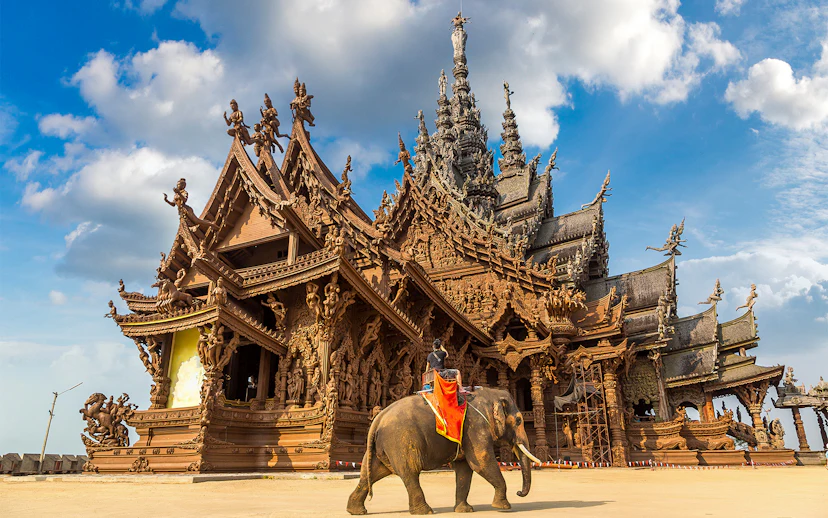
Plan Your Visit to Sanctuary of Truth
Sanctuary of Truth is Pattaya’s towering all-wood monument, best known for its dense hand-carved mythology and 105m spire by the sea. A visit feels more immersive than restful: you’ll wear a hard hat, move through active restoration zones, and take in four richly symbolic halls that can feel visually overwhelming if you rush. The biggest difference between a good visit and a forgettable one is timing your entry around a guide slot and the cultural show. This guide covers exactly how to do that.
Quick overview: Sanctuary of Truth at a glance
This is the section to read first if you want to avoid poor timing, extra waiting, or a rushed visit.
- When to visit: Daily, 8am–6pm. The first hour after opening and the last 90 minutes of the afternoon feel noticeably calmer than late morning, because most tour coaches and photo stops bunch up between about 10:30am and 2:30pm.
- Getting in: From ฿500 for standard daytime entry. Guided entry also starts at ฿500 because the regular ticket includes the official tour, while evening entry starts at ฿700; booking a few days ahead is smart on weekends, Thai holidays, and during the November–February high season.
- How long to allow: 2–3 hours for most visitors. It stretches closer to 3 hours if you stay for the Thai dance show, linger at the view decks, or add a boat or carriage ride.
- What most people miss: The hilltop viewpoint before you go down, the waterfront side angles after the main tour, and the symbolic differences between the four wings all make the visit richer than just photographing the central hall.
- Is a guide worth it? Yes here, because the standard ticket already includes one and the carvings make far more sense once someone explains what each hall represents.
🎟️ Preferred slots for the Sanctuary of Truth can fill up a few days ahead during cool-season weekends, long weekends, and holiday periods. Lock in your visit before the time you want is gone.
Jump to what you need
🕒 Where and when to go
🗓️ How much time do you need?
🎟️ Which ticket is right for you?
🗺️ Getting around
♿ Facilities and accessibility
Where and when to go
How do you get to Sanctuary of Truth?
The site sits in North Pattaya’s Naklua neighborhood, around 5km from central Pattaya and about 3km from Dolphin Circle, so it’s easy enough to reach but not somewhere you’ll usually pass by on foot.
206/2 Moo 5, Soi Naklua 12, Naklua, Bang Lamung, Chonburi 20150, Thailand
- Taxi / rideshare: Sanctuary of Truth main entrance → 15–20 min from central Pattaya → easiest option if you want the least walking.
- Songthaew: Naklua Road to Soi 12 → then 10–15 min walk → cheapest route, but the last stretch is less appealing in midday heat.
- Motorbike taxi: Naklua Soi 12 junction → 3–5 min ride → useful if you arrive by shared transport and don’t want the final walk.
- Private car: Hilltop parking lot → direct access to ticketing → free parking makes this the simplest choice for families.
Which entrance should you use?
There is one main visitor entrance, but the part people get wrong is thinking the hilltop ticket area is the monument itself. You still need to head down to the sanctuary level after check-in, either on foot or by shuttle tram.
- Main entrance: Located at the hilltop ticket office on Soi Naklua 12. Best for all visitors. Expect 5–15 min wait on weekday mornings and around 20–30 min on weekends and holidays.
When is Sanctuary of Truth open?
- Monday–Sunday: 8am–6pm
- Last entry: Around 5pm for the daytime visit
When is it busiest? Weekends, Thai holidays, and the November–February high season are busiest from late morning through midafternoon, when guided groups, show audiences, and photo stops overlap.
When should you actually go? Aim for 8am–10am if you want cooler walking conditions, or after 4pm if you want softer light on the woodwork and fewer people crowding the central hall.
How much time do you need?
| Visit type | Route | Duration | Walking distance | What you get |
|---|---|---|---|---|
Highlights only | Main hall → viewpoints → guided walkthrough → exit | 1–1.5 hrs | ~0.8 km | Best if you mainly want to see the wooden architecture, hear the core philosophy behind the carvings, and visit the main viewing areas. |
Balanced visit | Main hall → carving areas → viewpoints → Himmapan Forest → mini zoo → food/drink stop → exit | 2–3 hrs | ~1.5 km | The ideal pace for most visitors. You’ll have enough time for the guided tour plus quieter areas beyond the central structure without rushing the visit. |
Full exploration | Full cultural complex route → carving demos → carriage or elephant ride areas → viewpoints → food stops → shopping → exit | 3.5+ hrs | ~2.5 km | Best if you want to experience the full site beyond the main castle itself. The extra time helps because the park-style layout spreads attractions and rest areas across a large waterfront complex. |
Which Sanctuary of Truth ticket is best for you
| Ticket type | What's included | Best for | Price range |
|---|---|---|---|
Sanctuary of Truth Day Tour | Entry to the Sanctuary of Truth with an expert guide during daytime visiting hours | Exploring the carvings, viewpoints, and surrounding attractions with full natural light for photos and architecture details | From ฿451 |
Sanctuary of Truth Night Tour | Evening entry to the Sanctuary of Truth with an expert guide | Experiencing the wooden structure and waterfront atmosphere after dark in a quieter setting | From ฿701 |
How do you get around Sanctuary of Truth?
Sanctuary of Truth is best explored on foot in about 2–3 hours, and the route feels manageable once you understand that the visit starts at the hilltop entrance and then drops down toward the waterfront monument. The main focal point is the towering central hall, with the four symbolic wings radiating out from it.
Key areas
- Hilltop viewpoint: Full façade and sea backdrop → best first stop for scale and orientation → 10–15 min.
- Central hall: The tallest carved chamber and symbolic heart of the sanctuary → look up before you photograph → 20–30 min.
- Four wings: East, West, South, and North halls with different philosophical themes → the most rewarding part if you slow down → 30–45 min.
- Waterfront path: Side angles of the structure with open sea behind it → best late-afternoon photo stop → 10–15 min.
Maps and navigation tools
- Map: Simple on-site orientation materials cover the monument and grounds → pick them up before you descend from the ticket area.
- Signage: Basic wayfinding is enough for the main route, but the symbolism is dense enough that you’ll get more from following the guide than relying on signs alone.
- Audio guide / app: The official guided tour is the main interpretation tool here, and it adds more value than trying to self-navigate the carvings without context.
💡 Pro tip: Start with the hilltop viewpoint before you join the tour, then save the waterfront path for after the interior visit — that way the exterior finally makes visual sense once you’ve seen what the wings represent inside.
What are the most significant spaces in Sanctuary of Truth?

Central hall
Theme: Cosmology and shared spiritual wisdom
This is the dramatic core of the entire structure, where the ceiling height, carved columns, and layered symbolism hit hardest. Most visitors photograph it quickly and move on, but the real payoff is looking upward at the suspended figures and the way the carvings pull Hindu, Buddhist, and regional influences into one visual story. The details nearest eye level are only half the experience.
Where to find it: Directly at the heart of the monument, where all 4 wings connect.
Eastern hall
Theme: Family, gratitude, and human relationships
The eastern wing is one of the most emotionally legible parts of the sanctuary, focusing on parents, children, and filial love rather than spectacle. Visitors often move through it faster than the central hall, but this is where the project’s moral message becomes easiest to grasp. The smaller groupings of figures are what most people miss, and they’re often the most human.
Where to find it: Off the main central hall on the east-facing side of the structure.
Western hall
Theme: Creation and the 4 elements
This wing is where the sanctuary leans hardest into mythic storytelling, with carvings tied to earth, water, wind, and fire. It’s worth slowing down here because the scenes are more narrative than decorative, and they make the monument feel like a carved philosophy text rather than a photo backdrop. Many visitors miss how the elemental themes repeat across the wall panels.
Where to find it: Off the central hall on the west-facing side, closer to the sea breeze and open outlook.
Southern hall
Theme: Celestial order, the sun, moon, and stars
The southern wing ties life on earth to cosmic movement, and it rewards visitors who like symbolic detail. This area is easier to rush because the carvings read as dense ornament from a distance, but look closer and you’ll spot astronomical figures and repeating celestial patterns. It often feels a little quieter than the central zone, which makes it easier to study.
Where to find it: South side of the monument, branching off from the central chamber.
Northern hall
Theme: Taoism, Confucianism, and Mahayana thought
This is one of the most distinctive wings because it broadens the sanctuary beyond Thai and Hindu-Buddhist imagery into Chinese philosophical traditions. Visitors often remember the scale here less than the calm, ordered feel of the compositions once a guide explains them. The biggest thing people miss is how deliberately different this wing feels from the more overtly mythic western side.
Where to find it: North side of the sanctuary, opposite the southern celestial wing.
Hilltop viewpoint
Theme: Best overall perspective
This is not part of the interior, but it’s one of the most important stops because it gives you the full silhouette before you get overwhelmed by detail inside. Many visitors head straight down and only realize later that they skipped the cleanest wide shot of the visit. It is especially strong in late afternoon, when the façade catches warmer light.
Where to find it: Immediately after the entrance and ticketing area, before you descend to the main monument level.
Facilities and accessibility
- 🎒 Helmet station: Hard hats are issued before you enter because restoration work is still active inside the monument.
- 🚻 Restrooms: Restrooms are available in the visitor area, and it’s smartest to use them before heading down to the sanctuary level.
- 🍽️ Restaurant and café: A sea-view restaurant and café serve Thai food, snacks, and drinks, and they are most useful as a convenient break rather than a destination meal.
- 🛍️ Gift shop: The main shop near the exit focuses on wooden crafts, small carvings, and Sanctuary-themed souvenirs.
- 🚋 Shuttle tram: A free tram connects the hilltop entrance and the monument level for visitors who want to avoid the steep walk.
- 🅿️ Parking: Free on-site parking is available at the main entrance, which makes self-driving practical for families and groups.
- ♿ Mobility: The site is only partly accessible, because there is a steep descent from the entrance and some interior sections still involve steps, wooden floors, and active work zones, though the tram helps with the biggest uphill and downhill section.
- 👁️ Visual impairments: The official guided tour is the most useful support here, because the carvings are extremely dense and much easier to understand through spoken explanation than from visual signage alone.
- 🧠 Cognitive and sensory needs: The first hour after opening is the calmest window, while the performance area and late-morning group-tour period are usually the busiest and noisiest parts of the visit.
- 👨👩👧 Families and strollers: A compact stroller is easier than a large one, but the full route is not smoothly pushchair-friendly end to end because of slopes, stairs, and crowded viewing areas.
Sanctuary of Truth works best for children who like animals, performances, and big visual spaces, and it is easier with school-age kids than with toddlers who dislike waiting through guided explanations.
- 🕐 Time: Around 90 minutes to 2 hours is realistic with young children if you prioritize the main hall, the show, and one activity instead of trying to study every wing.
- 🏠 Facilities: The tram, restrooms, shaded seating, and restaurant make the site more manageable than many heritage attractions.
- 💡 Engagement: Build the visit around the dance show or animal-feeding areas, because children usually connect faster with those than with the symbolism-heavy guided sections.
- 🎒 Logistics: Bring water, hats, and a light bag, and avoid the hottest midday slot if your child struggles with heat or standing still.
- 📍 After your visit: North Pattaya seafront cafés and casual seafood stops are the easiest follow-up if children need food and a reset before heading back into town.
Rules and restrictions
What you need to know before you go
- Entry requirement: Your admission includes the official guided round, and you’ll be issued a hard hat before entering the active restoration zone.
- Bag policy: A small day bag is easiest here, because stairs, narrow passages, and crowded viewing points make bulky bags awkward.
- Re-entry policy: Treat this as a single continuous visit rather than a come-and-go site, so eat, hydrate, and use the restroom before you head down.
Not allowed
- 🖐️ Touching carvings and climbing: Keep hands off the sculptures and stay behind barriers, because the wood is actively conserved and easily damaged up close.
Photography
Photography is generally allowed across the grounds and in most viewing areas, which is part of why the hilltop deck and central hall are so popular. The distinction is less about entire no-photo zones and more about equipment: tripods, drones, and professional-style setups usually need advance permission rather than standard visitor access. Flash is best avoided inside the carved halls, where the atmosphere and detail are better appreciated in natural light.
Good to know
- Tour timing: You won’t fully free-roam first, because most visits start around the next guided language slot, so arriving just before one saves dead time.
- Safety gear: The hard hat is not just for show, and staff do expect you to keep it on in active restoration areas.
Practical tips
- Booking and arrival: Book a few days ahead if you’re visiting on a cool-season weekend or Thai holiday, and arrive 15–20 minutes before the next guide slot so you’re not standing around in the sun waiting for the next departure.
- Pacing: Don’t spend all your energy in the central hall; the eastern and northern wings are where the symbolism becomes clearer, and they’re often the parts visitors rush even though they’re less congested.
- Crowd management: The 8am opening slot is the easiest if you want cleaner photos and cooler walking, while after 4pm gives you warmer light on the exterior without the thick late-morning group-tour flow.
- What to bring or leave behind: Bring a small bag, not a heavy backpack, because you’ll be navigating stairs, wooden walkways, and tight photo points while also wearing a hard hat.
- Food and drink: If you want the on-site sea view without the busiest tables, eat after your tour or after the 3:30pm show rather than at the midday peak when guided groups break at once.
- Photos: Take your wide exterior shots from the hilltop first, then save the waterfront path for last — the carvings read better from outside once you’ve already heard what each wing represents.
What else is worth visiting nearby?
Commonly paired: Big Buddha Hill
Distance: ~8 km — 20–25 min by car
Why people combine them: It gives you a second landmark-style stop on the same day, and the contrast works well: one site is immersive and detail-heavy, while the other is faster, more open, and viewpoint-driven.
Commonly paired: Pattaya Floating Market
Distance: ~15 km — 30 min by car
Why people combine them: Both are popular for travelers who want a more cultural Pattaya day, and the floating market adds food, shopping, and easier family pacing after a more structured guided visit.
Also nearby
Lan Pho Naklua Market
Distance: ~4 km — 10 min by car
Worth knowing: It makes the most sense as a practical post-visit stop for seafood and local-market atmosphere if you’re staying in North Pattaya.
Wong Amat Beach
Distance: ~3 km — 10 min by car
Worth knowing: This is the easiest nearby reset if you want sea views and a quieter shoreline after a visually intense, guide-led attraction.
Eat, shop and stay near Sanctuary of Truth
- On-site: The sea-view restaurant and café are the easiest option for Thai food, snacks, and cold drinks, and they make the most sense as a convenience stop rather than a meal to plan your day around.
- Lan Pho Seafood Market: 10-min drive, Lan Pho Naklua; casual seafood and local prices make this a better-value post-visit meal if you want something more local than tourist-strip dining.
- Wong Amat hotel cafés: 10–15-min drive, Wong Amat; best for coffee, dessert, and air-conditioning if you want a quieter break after the monument.
- Central Pattaya restaurants: 20-min drive, Beach Road area; the widest choice if you’re already heading back into town and want everything from Thai to Indian and international food.
- 💡 Pro tip: Eat after your tour, not before it — the restaurant feels busiest when guided groups and show audiences break at the same time.
- Sanctuary of Truth gift shop: Handmade woodcrafts, small carvings, and venue-specific keepsakes near the exit make this the most relevant shopping stop.
- Lan Pho Naklua Market: Better for local snacks and everyday browsing than polished souvenirs, and only worth the detour if you’re staying in North Pattaya.
Naklua and Wong Amat make sense if you want a quieter Pattaya base with easier access to the sanctuary and a more resort-like coastline. They are calmer than central Pattaya and feel more relaxed in the evenings, but they are usually less convenient if nightlife, shopping, and frequent songthaew routes matter to you. For a short, slower trip, the area works well. For a first Pattaya stay focused on variety, it can feel slightly tucked away.
- Price point: The area leans mid-range to upscale, especially around Wong Amat, though simpler guesthouses exist deeper into Naklua.
- Best for: Visitors who want a quieter beach stay, easy car access to the sanctuary, and fewer central-Pattaya crowds.
- Consider instead: Central Pattaya suits shorter stays better if you want easier transport, more restaurant choice, and a wider mix of attractions, while Pratumnak works better for travelers who want a calmer residential base without going fully north.
Frequently asked questions about visiting Sanctuary of Truth
Most visits take 2–3 hours. That gives you enough time for the guided circuit through the monument, the hilltop and waterfront viewpoints, and one cultural performance if your timing works. If you add a boat ride, costume photos, or another paid activity, it can stretch closer to 3 hours.
No, you usually don’t need to book far ahead, but it is still smart on weekends, Thai holidays, and during the November–February high season. A few days is usually enough. Booking ahead also helps if you want to arrive at a specific time and move straight into the next guide slot.
Usually not in the same way it is at a major European landmark, because the bigger wait is often for the next guided round rather than a very long security line. If you’re visiting on a peak weekend, pre-booking still helps, but arriving at a quieter hour matters more than paying extra for fast entry.
Arrive 15–20 minutes early. That gives you enough time to check in, collect your hard hat, use the restroom, and get down to the monument level without missing the next language tour. It also leaves time for the hilltop photo stop before the main visit begins.
Yes, you can bring a small bag or backpack. A compact day bag is much easier than a large one because the visit includes stairs, tighter walkways, and crowded viewing spots. If you’re carrying camera gear, pack lightly so you’re not fighting the bag and the hard hat at the same time.
Yes, photography is generally allowed, and the site is one of Pattaya’s strongest photo stops. The main limitation is equipment rather than casual shooting: drones, tripods, and professional setups usually need prior permission. The best exterior shots usually come from the hilltop deck first and the waterfront path last.
Yes, the attraction works very well for groups. It already runs guided rounds in multiple languages, and it is a common stop for Pattaya tours and large travel parties. If your group wants more flexibility or a single-language explanation, arranging a private guide or private transfer makes the visit smoother.
Yes, it is suitable for families, especially with school-age children. The monument itself is visually dramatic, and the dance show, animal-feeding areas, carriage rides, and sea views help break up the more explanation-heavy parts of the visit. Younger children may tire faster if you choose the hottest midday slot.
It is only partly wheelchair accessible. The steep approach from the entrance is manageable with the shuttle tram, but the monument itself still includes wooden floors, some steps, and active restoration zones that make full access difficult. Visitors with mobility needs should plan for a partial rather than completely barrier-free visit.
Yes, food is available both on-site and nearby. The sea-view restaurant and café on the grounds are the easiest option for a quick break, while North Pattaya and Naklua have better-value seafood and café stops if you want to eat after the visit. The on-site option is convenient, not essential.
There is no strict dress code like you’d find at a fully active religious complex, but modest clothing still makes sense. Lightweight clothes that cover a bit more are more comfortable with the hard hat, the sun, and the temple-like atmosphere. Swimwear and beachwear are better saved for later in the day.
Yes, the cultural performances are included in the standard entry ticket. The usual showtimes are around 11:30am and 3:30pm, which is why many visitors build their whole visit around one of those windows. If you arrive between them, you may need to decide whether to wait or skip the show.